
How to run a local-first job search
Keep your private job-search workspace on your computer while understanding the limited outside connections that useful features still require.
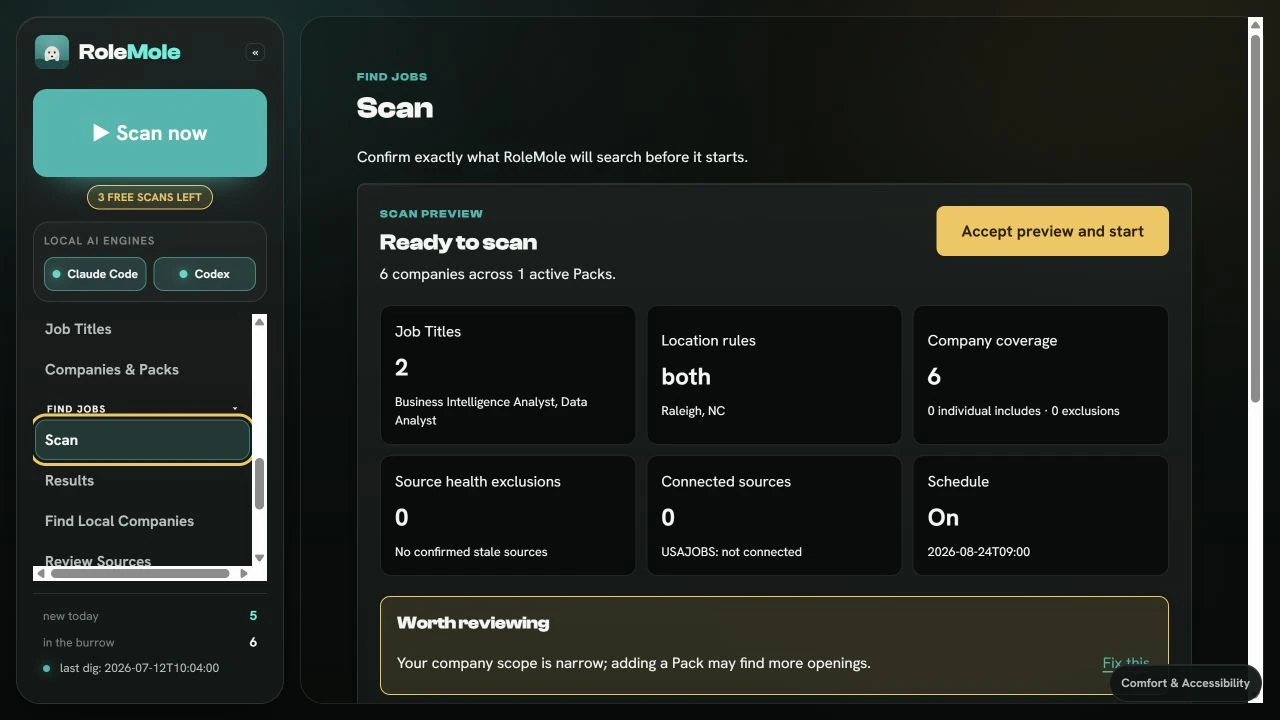
A local-first job search keeps the private working set under your control: target roles, results, résumés, profile answers, drafts, applications, notes, and history live on your computer.
That is different from claiming that a useful job-search product never connects to anything.
Start with an honest boundary
A direct-source search must contact public career sites. A purchase must involve a payment provider. A licensed app may need to validate access. An application sends information to the employer when you choose to submit it.
The useful privacy question is not “Does any network request exist?” It is:
What information leaves, for which feature, to which service, for how long, and under whose control?
Keep the private workspace local
The strongest local-first boundary keeps these records off a central RoleMole account:
- roles and keywords;
- employer choices;
- results and saved jobs;
- résumé text and files;
- profile answers;
- tailored materials;
- application history;
- tracker notes and dates; and
- AI prompts and outputs.
Backups should also remain deliberate and scoped.
Make outside paths feature-specific
Useful exceptions should be narrow:
- career-source scans send ordinary requests to employer systems;
- Stripe processes payment and receipt information;
- licensing handles the minimum entitlement and device-seat state;
- update services provide versioned release metadata and files;
- optional AI tools process only the content the user chooses under that provider’s terms;
- support receives only what the user deliberately sends; and
- employer forms receive application information during a deliberate application.
Avoid turning those exceptions into a general behavior profile.
Keep analytics away from the search
Website teams can learn whether pages, downloads, and broad conversion paths work without collecting roles, sectors, companies, calculator values, résumé content, license keys, or application behavior.
Aggregate counters are enough for many operating questions. Session replay and cross-site advertising profiles are not required to understand whether a download link works.
Treat phone access as a new boundary
A paired phone can be useful, but it changes the system. Safe design requires explicit pairing, device revocation, strict commands, encrypted payloads, replay protection, narrow file access, and honest offline behavior.
RoleMole Companion is designed so the relay handles ciphertext rather than readable results or résumé payloads. It is not a remote-desktop tunnel.
Choose control over absolutes
“Nothing leaves your computer” sounds simple, but it hides the real choices. A better promise is specific:
Your job-search workspace stays on your computer. RoleMole connects to outside services only when a clearly described feature or essential product function requires it.
Read the current privacy boundary or see how the complete workflow works.

Application assistance vs. blind auto-apply
Understand which application tasks are safe to assist, where human review matters, and why submission volume is not the same as a good search.

How to find jobs directly on company career sites
Build a focused direct-source search that finds useful employer pages without drowning in bookmarks or pretending every source is hiring.
Reading is the warm-up. The search is the work.
Put this into practice in a workspace that finds direct-source roles and keeps the next action in front of you.