
How to find jobs directly on company career sites
Build a focused direct-source search that finds useful employer pages without drowning in bookmarks or pretending every source is hiring.

Job boards are useful for discovery, but an employer’s own career site is often the clearest place to verify the opening, read the current description, and apply through the employer’s chosen system.
The hard part is not knowing that career pages exist. It is building a direct-source routine you can maintain.
Choose employers with a reason
Start with groups that match your search:
- employers in a sector where your skills transfer;
- organizations in your location or remote-work range;
- companies connected to products or problems you understand;
- employers similar to one that already produced a strong match; and
- public agencies or institutions with distinct hiring systems.
A long list is not automatically a good list. A smaller group you can explain and maintain is more useful than hundreds of names added without verification.
Confirm the official hiring source
Prefer a link from the organization’s official domain or a clearly attributable applicant-tracking system. Check that the source:
- identifies the correct organization;
- exposes real job records or a structurally valid empty board;
- does not redirect to an unrelated staffing inventory;
- supports a direct path to the job detail; and
- remains safe and reachable.
A working source with zero current openings is still a valid source. It should not be described as “actively hiring” until it actually shows openings.
Search by role family, not one exact title
Organizations name similar work differently. A data-focused role might appear as Data Analyst, Business Intelligence Analyst, Reporting Analyst, or another title shaped by the team.
Use a small family of relevant titles plus skill terms. Then review the actual responsibilities, seniority, and location instead of treating the title as proof of fit.
Keep the employer link with the result
When you save a role, retain the direct employer URL and the description you used. Aggregated listings can expire, change, or point through several layers. The direct source makes later verification and application review easier.
Respect source health
Career sites change providers, URLs, filters, and page structures. Treat “no openings,” “page failed,” and “wrong organization” as different states.
If a source fails, do not silently convert that failure into “zero jobs.” Retry carefully, verify the official path, and remove an unsafe or ambiguous source from active checking until it is repaired.
Make the routine sustainable
Batch source checks at a pace the sites can handle. Deduplicate repeated roles. Preserve the last useful state. Stop and resume rather than restarting a large search from zero.
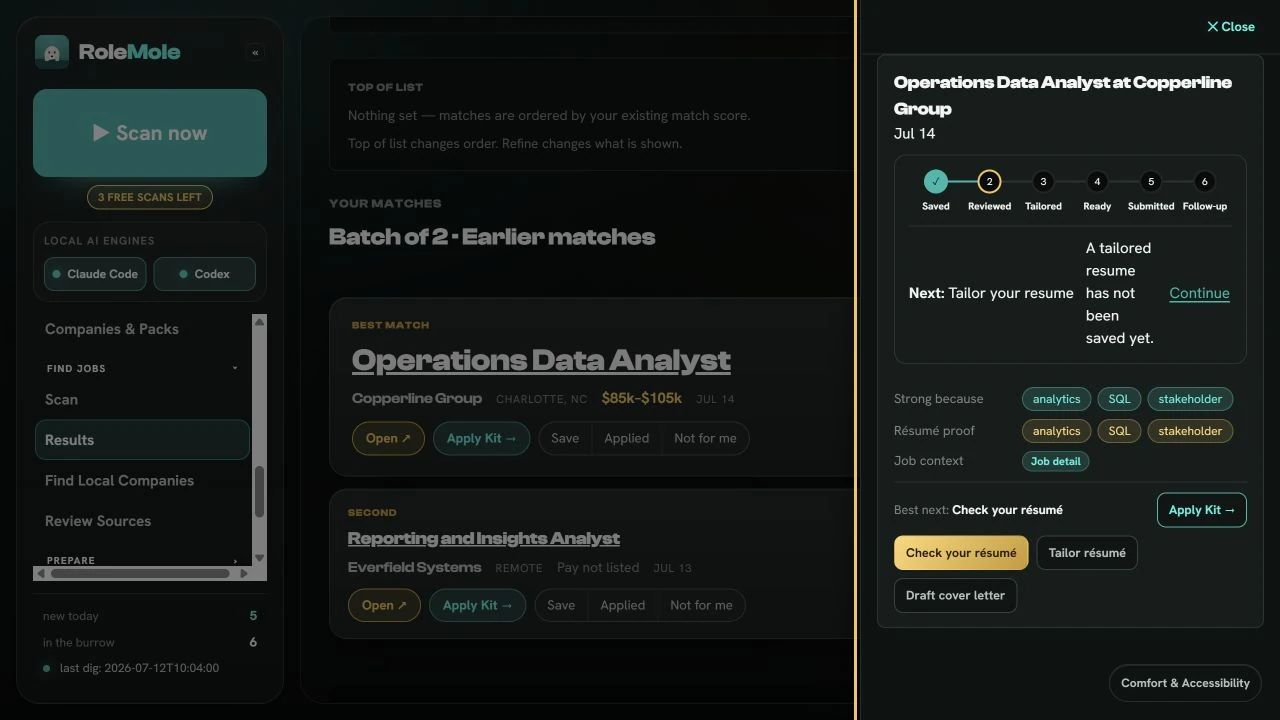
That maintained system is where direct-source searching becomes valuable. RoleMole’s packs and coverage model is designed around verified official sources, honest empty states, user-added companies, and a private local workflow, not a public directory of every source URL.
To try the full desktop flow, start with three qualifying scans. No account, email, or card is required.

Application assistance vs. blind auto-apply
Understand which application tasks are safe to assist, where human review matters, and why submission volume is not the same as a good search.
How to find relevant roles without endless tabs
Use a search mission, direct sources, match evidence, and bounded review to reduce tab churn without outsourcing your judgment.
Reading is the warm-up. The search is the work.
Put this into practice in a workspace that finds direct-source roles and keeps the next action in front of you.